- Home /
- Resilience at Work® Scales Overview /
- R@W Team Scale
Resilience at Work® Team
What is the R@W Team Scale?
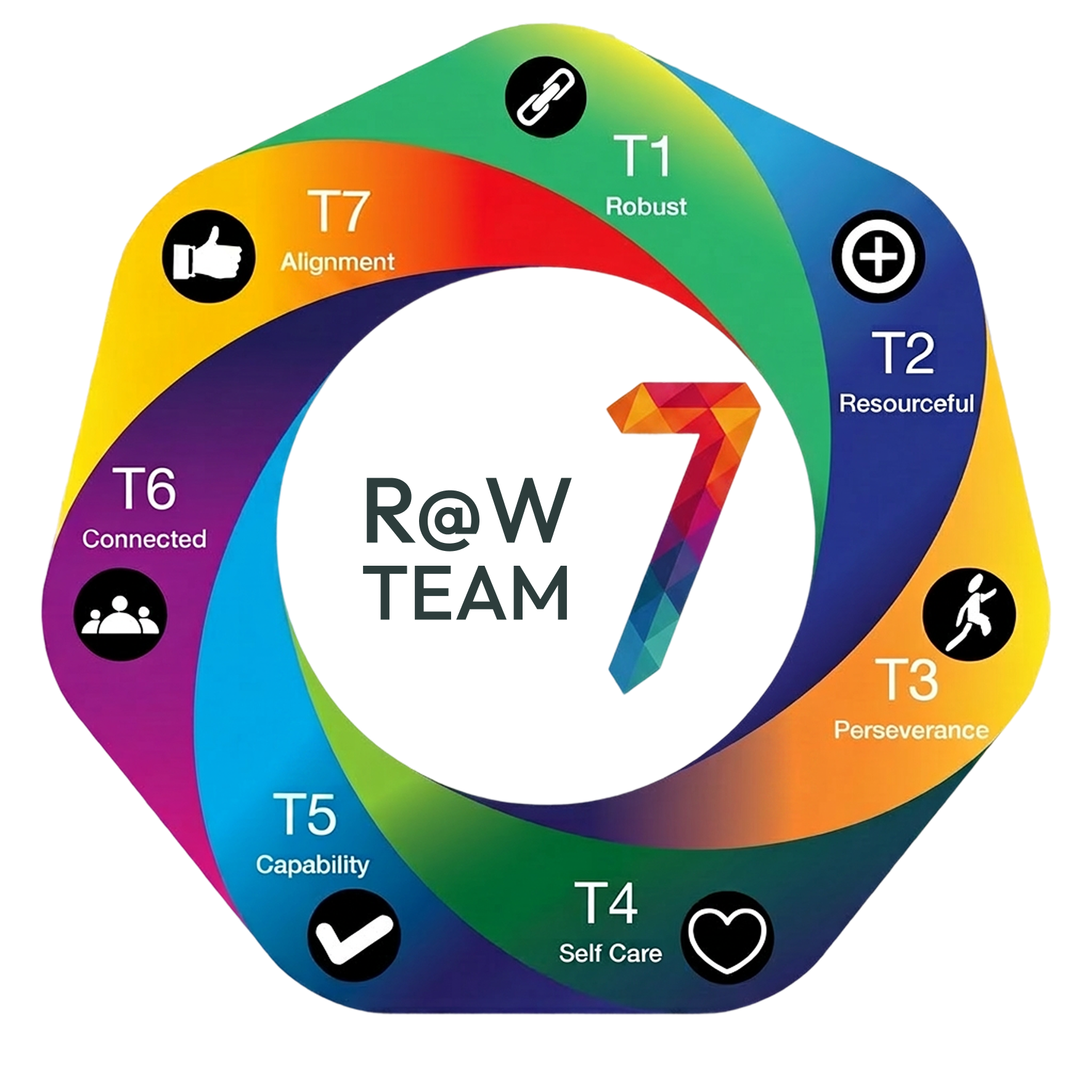
The R@W Team Scale moves beyond the factors which contribute to individual resilience at work, and provides a way to measure resilience in groups of adults working to achieve a shared objective: a team. The R@W Team Scale was published in the American College of Occupational and Environmental Medicine in 2018 and highlighted the important finding that collective, not individual, resilience best predicted team performance. While individual resilience is critical in a high performance team, member capacity to deliver on shared objectives is determined by the degree to which their norms and patterns of collective behaviour rate well on 7 team dimensions.
The Team Scale underpins two valuable assessments available to accredited users: the R@W Team test (for measuring team resilience) and the R@W Leader test (for measuring team members’ assessment of leader effectiveness in setting the conditions for team resilience). The R@W Leader test is available in both a self-rated format, and a 180° assessment.
The R@W Team and R@W Leader tests belong to a suite of assessments included in our Resilience at Work Toolkit. You can learn more about how our Team and Leader assessments work together with our Individual and Enterprise assessments in our Introduction Pack below or check out one of our Sample Team and Leader 180° reports.
Team Resilience and Leader Effectiveness.
A group’s collective capacity to perform optimally while maintaining wellbeing, adapt to change and setbacks and position for sustainable success.
In today’s workforce most people work in teams, sometimes in multiple teams that may be temporary or fixed within an organisational structure. To optimise resilience it is important to invest not only in individual but also in collective and leader behaviours.
To create resilience within a group of people it makes sense that each person needs to develop their personal resilience in order to contribute as an effective member of a team – but a group of resilient individuals does not guarantee a resilient team.
Team member behaviours need to be aligned (not in conflict) in order for a group to be an effective whole. Purpose, goals and values are good examples of where alignment counts. Misalignment impacts negatively on the group’s performance.
The R@W Team assessment measures 7 factors required to build team resilience. The R@W Leader assessment measures the degree to which the leader’s behaviours are setting the conditions for team behaviour to align around those 7 factors.

Meet the Team Scale
T1 Robust
T1 Robust
T2 Resourceful
T2 Resourceful
T3 Perseverance
T3 Perseverance
T4 Self-care
T4 Self-care
T5 Capability
T5 Capability
T6 Connected
T6 Connected
T7 Alignment
T7 Alignment
R@W Team and Leader Assessment Benefits.
-
Is validated and specifically designed for the workplace
-
Builds on the other aspects of the R@W Toolkit to create a systemic approach
-
Considers team resilience as a dynamic state that needs continual focus
-
Takes into account the impact of the organisational context in which the team is working
-
Provides a comprehensive feedback report that is easily translated into practical actions
-
Places emphasis on building strengths in addition to managing current and future challenges
-
Is quick and easy to administer, taking ~15 minutes to complete online.